A pixie haircut can feel wonderfully direct: wash less hair, show your face, and stop hiding behind a ponytail. The part that gets skipped in inspiration photos is the commitment after week three, when the nape has grown in, the fringe has chosen its own direction, and the salon texture has vanished. A good pixie cut is built around your growth pattern and routine, not around the shortest picture you saved at midnight.
Decide what you want short hair to solve
Start with the reason you want a pixie. Perhaps your ends are damaged, your thick hair takes too long to dry, or you want a sharper outline around the face. Each reason points to a different version. A close crop removes the most bulk but exposes the scalp and hairline. A long pixie keeps more softness and gives a little room to change the part, but it needs shape so it does not become an accidental bob.
Think about your first month rather than the first hour. Will you wear glasses? Do you exercise most days? Do you need to pin the front back for work? A fringe that looks loose and elegant in a photo may fall into your eyes during a video call. A very short nape feels clean, but it reveals growth quickly. There is no bad answer; it is simply better to choose the maintenance you actually tolerate.
Bring reference images with a similar hairline and texture to yours. A pixie on thick, straight hair behaves differently from one on fine waves or tight curls. It is also worth showing an image you dislike. “I want movement, but not spiky pieces at the crown” is far more useful to a stylist than naming a celebrity cut.
Choose between soft, textured, and sharp shapes
A soft pixie usually keeps length around the fringe and temples, with a nape that is tapered rather than shaved. It works well for someone new to short hair because the perimeter can be tucked, swept, or grown out without looking unfinished. The shape still needs a plan around the ears: pieces that are too long can stick out, while pieces that are too short can make glasses sit awkwardly.
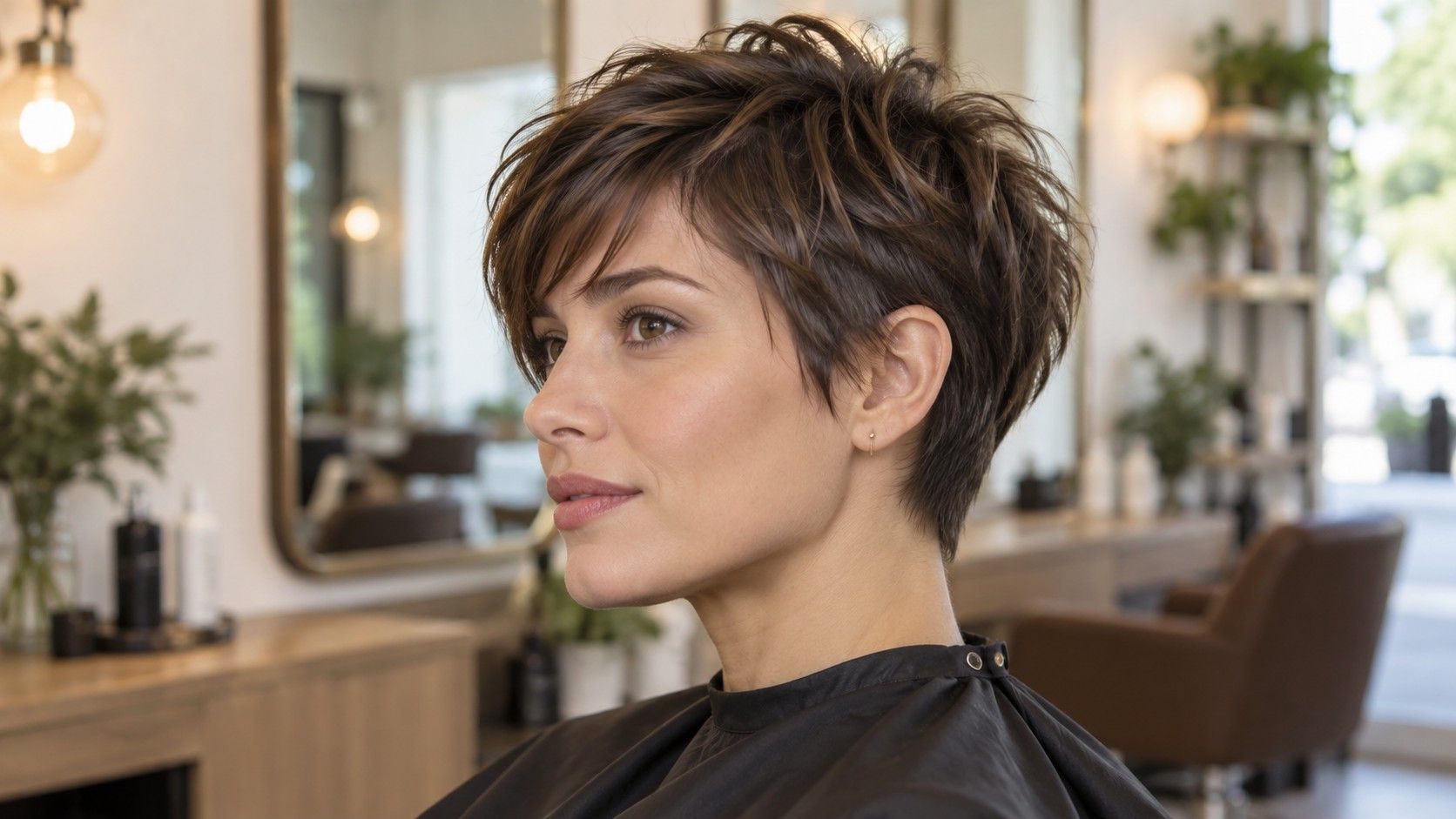
A textured pixie uses uneven lengths and deliberate separation. It can be great for dense hair that would otherwise sit like a solid cap, or for wavy hair that needs a place to move. Texture is not the same as random choppiness. Ask where the texture will live: at the crown for lift, through the fringe for softness, or around the temples to avoid a severe outline.
A sharp crop has cleaner lines, often with clipper work at the nape or sides and more contrast between the short and long areas. It is striking, but it makes every growth change visible. If the idea of a fortnightly neck cleanup sounds tedious, choose a tapered nape rather than a skin-close one. A gentler transition gives you longer between appointments.
| Pixie shape | Best for | Maintenance reality |
|---|---|---|
| Long pixie | First-time short cuts and flexible styling | Needs shaping as it approaches bob length |
| Soft tapered pixie | Natural movement and an easy nape | Usually manageable between six-week trims |
| Textured pixie | Dense hair or visible wave | Needs a small amount of product to show shape |
| Close crop | A crisp, low-bulk silhouette | Requires the most frequent nape and side upkeep |
Let the cowlick and nape set the rules
A crown cowlick is not a flaw to be erased. It is a direction the cut needs to use. If it pushes hair forward, a longer fringe may work naturally. If it stands straight up, leaving the crown too short can create a permanent tuft no matter how much wax you use. Ask the stylist to assess it with the hair dry, because wet strands often conceal the pattern.
The nape deserves the same attention. Hair can grow upward, downward, or sideways there, and a clipper line that looks perfect on appointment day may blur quickly. A tapered nape is often the calmest option for a first pixie. It follows the natural growth and gives the hair a softer return as it grows. A hard undercut is a stronger commitment and can create an awkward shelf when you decide to grow it out.
Front growth direction matters too. If your fringe splits in the centre, a severe side-swept pixie will demand daily heat styling. If it naturally falls left, build the part on the left and use that advantage. Five seconds of cooperation with your hair beats fifteen minutes of correction every morning.
Be honest about styling time and product
Short hair does not always mean no styling. A pixie often dries quickly, but it can show a flat crown, a bent fringe, or a sleeping-on-one-side kink more clearly than long hair. Most people need a light mist of water, a dryer, and one product rather than a drawer full of tools. The sequence matters: set the roots first, then work on texture.
For a soft finish, use a small amount of cream or lightweight paste on dry ends. Rub it between your palms until it almost disappears, then pinch only the sections that need separation. For lift, use mousse or a root spray before drying and direct the hair opposite its final position for a few seconds. Heavy wax at the roots can make fine hair look greasy by noon.
Do a two-minute trial before agreeing to a cut. On a normal morning, time how long you are willing to spend with a dryer and product. If the answer is three minutes, tell the stylist. A dramatic textured crop can still be possible, but the cut should be designed to settle quickly rather than relying on a full styling routine.
Plan trims and grow-out while you are still in the chair
A pixie trim cycle is not a sales pitch; it is part of the shape. Close sides and a clipped nape may need attention every two to four weeks. A soft long pixie often holds for five to eight weeks, depending on density and how clean you want the outline. Waiting longer is possible, but the cut will change category: the fringe may become curtain-like and the ears will disappear first.
Ask for a grow-out map. The useful answer includes what to do when the top reaches the cheekbone, when the nape hits the collar, and whether the sides should be kept short during the transition. Growing everything at the same rate is rarely flattering. A stylist can keep the nape neat while allowing the top and fringe to gain length, which produces a soft bixie rather than a mushroom shape.
Keep a few photos of your own cut from the front, side, and back after the first week. They are better consultation material than a generic pixie cut image because they show your hairline, density, and the bits you actually liked. A successful pixie haircut is a relationship with its grow-out, not a one-day reveal.
What to ask before the first cut
Ask whether your hair density suits the reference, where the weight will remain, and whether clippers are planned at the nape or sides. If you have a cowlick, ask to see how it is being accommodated. If you wear glasses, put them on before the fringe is finalized. A short section near the temple can either frame the arm of the glasses neatly or constantly push against it.
Request a slightly longer first version if you are unsure. Hair can always come off, while an over-short fringe has no same-day solution. The best pixie cut is not necessarily the boldest one: it is the shape that works with your hair after sleep, has a trim schedule you can keep, and still feels like you when the styling product is not doing all the talking.