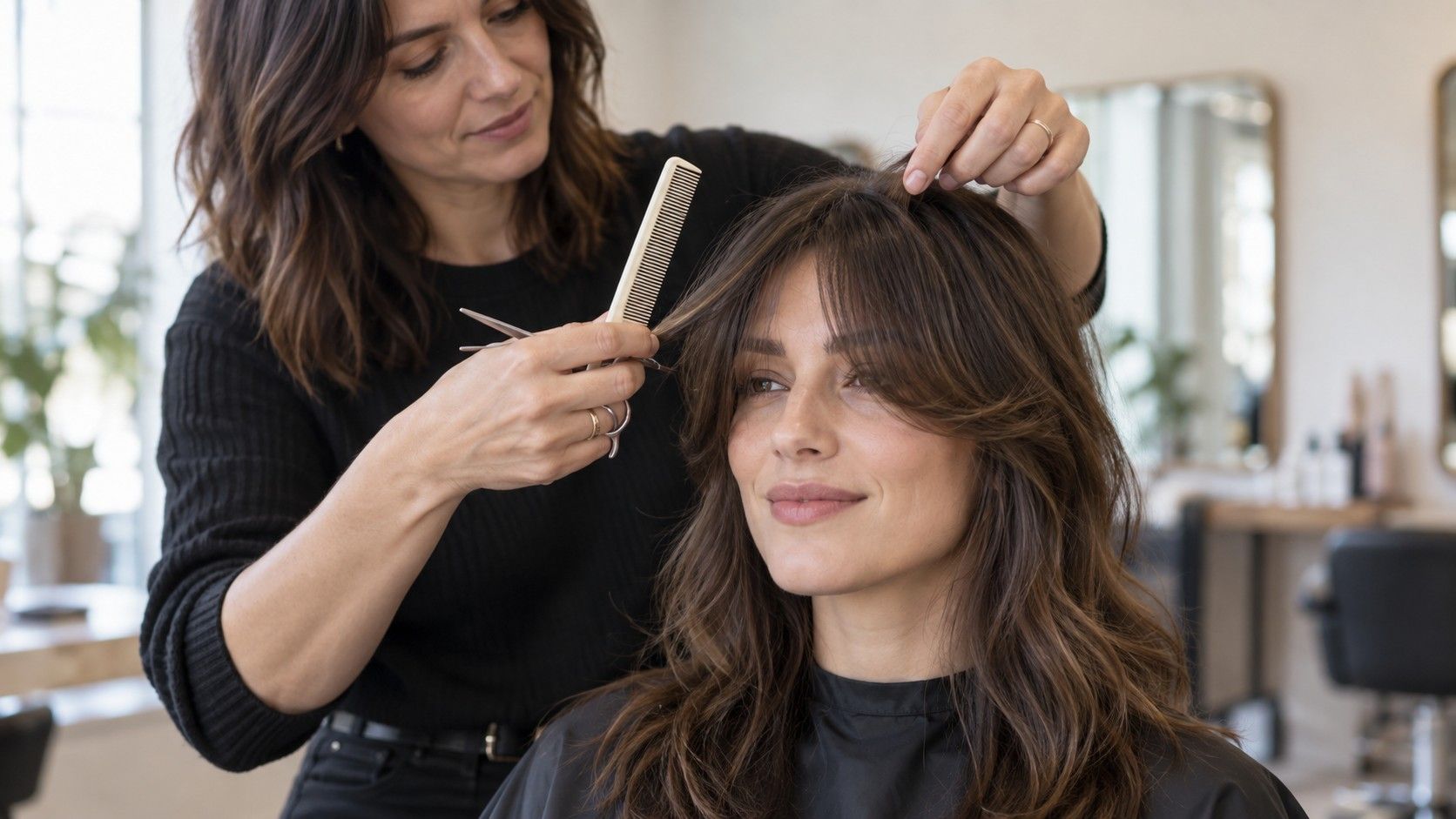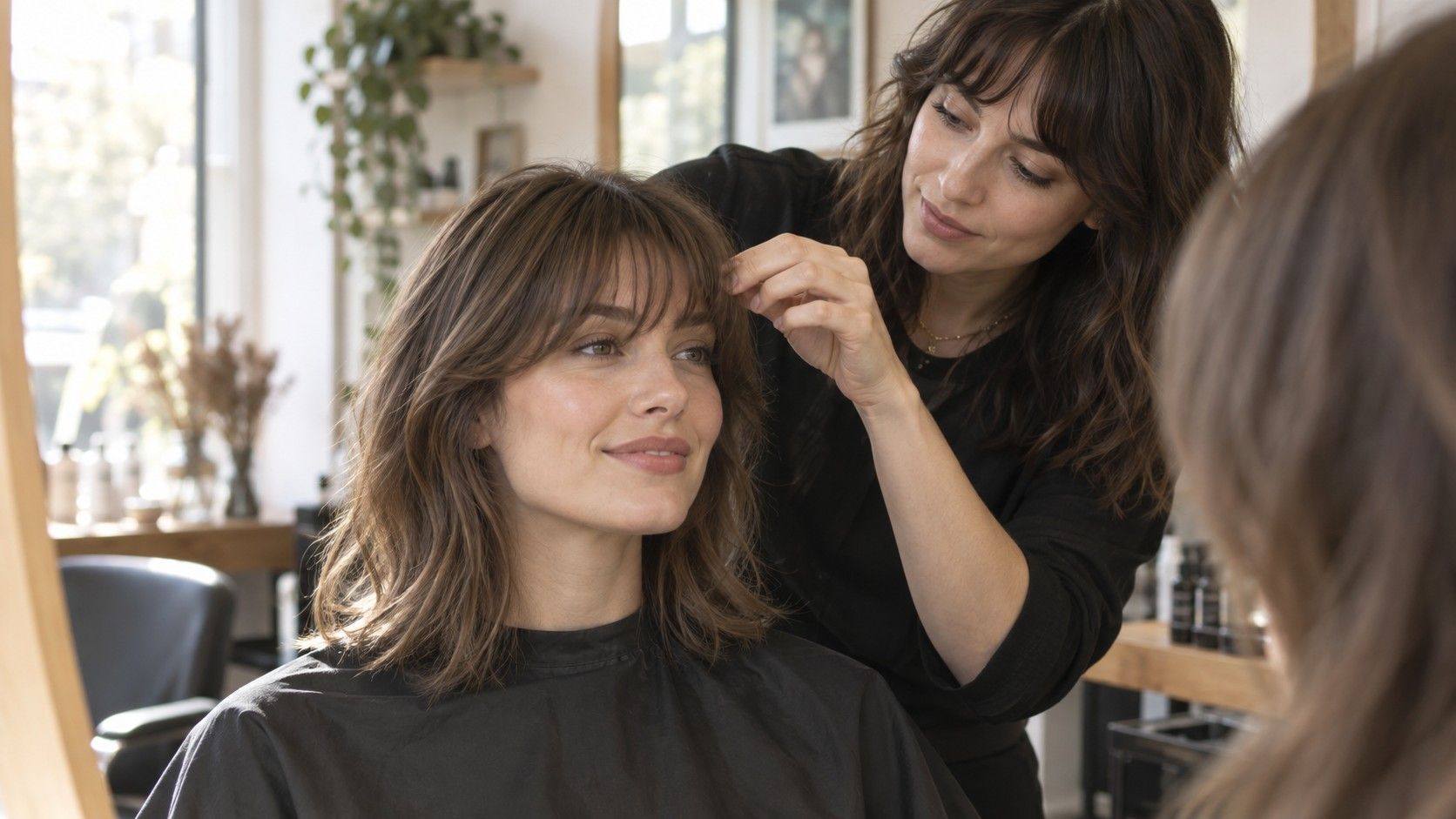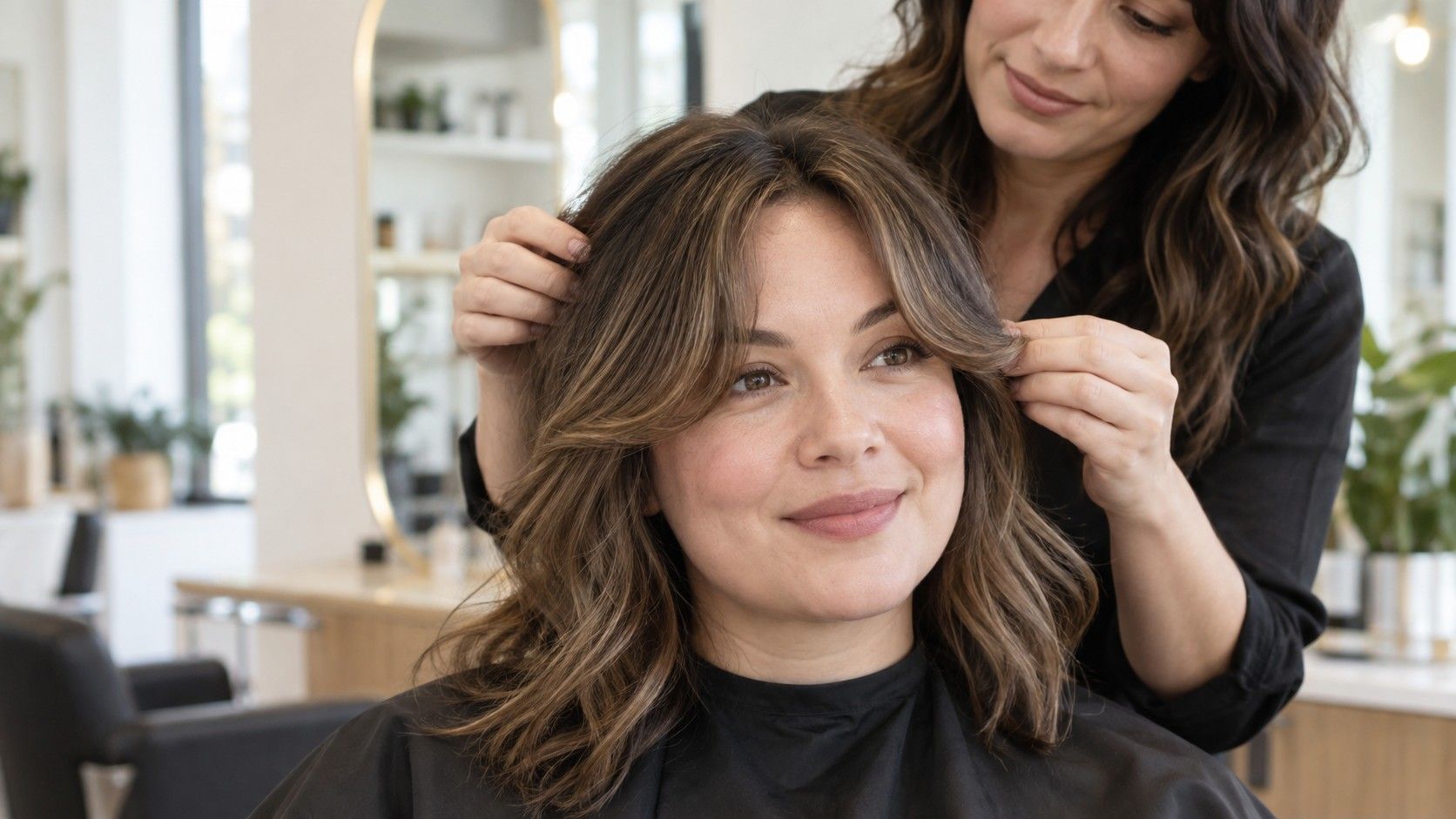
When someone asks for bangs for a big forehead and round face, the temptation is to hide as much forehead as possible. That can work for one mirror selfie and fail by lunchtime: a dense straight line often makes the face read shorter and wider. The more useful question is where the fringe begins, where it opens, and whether it still has a shape after a normal commute, a little humidity, and a pair of glasses.
Start with the job you want the fringe to do
A higher forehead and a round face are not competing problems, but they do ask for different adjustments. A fringe can reduce the amount of open skin above the brows, while its outer edges can add a little vertical movement at the temples and cheeks. The goal is not to erase the forehead. It is to make the transition from hairline to cheekbone look less abrupt.
Look at your face with your hair pulled back in daylight, then mark three points mentally: the widest part of the cheeks, the natural hairline, and the point where your jaw turns. If the cheeks are clearly widest, avoid choosing a fringe only because it looks thick in a salon photo. The line across the forehead matters, but the length of the pieces beside it matters just as much.
There is also a practical split between a high forehead caused by a naturally high hairline and one created by a strong crown cowlick. The first usually tolerates a soft, regular fringe. The second needs a part and direction that cooperate with the growth pattern. Fighting a cowlick every morning is a poor trade for a flattering first ten minutes after a blow-dry.
Curtain bangs are usually the safer first test
A curtain fringe gives coverage in the centre without building a solid wall from temple to temple. The shortest point can sit around the brow or just below it, then lengthen toward the cheekbones. That opening is useful on a round face because it creates a vertical seam rather than a horizontal cap. It also grows out more quietly than a blunt fringe, which matters if you are testing bangs for the first time.
The catch is width. Very narrow curtain bangs can look like two separate pieces and leave the centre of a big forehead fully exposed. Very wide ones can spread across the temples and make the face appear broader. Ask for a centre section that begins near the natural arch of each brow, then softens out to the cheekbone. That gives enough coverage without pushing volume sideways.
For fine hair, I would keep the centre fairly light and make the outer pieces a touch longer. Fine strands collapse quickly if the fringe is cut too deep into the crown. For thick hair, the stylist can remove internal weight rather than leaving a heavy triangular section. The difference is obvious at 4 p.m.: soft bangs separate in a deliberate way; overloaded bangs divide into random strips.
| Fringe option | What it does well | Watch for |
|---|---|---|
| Long curtain bangs | Softens a high forehead and frames the cheekbones | Can split too far apart on a strong cowlick |
| Side-swept fringe | Creates an angled line across the forehead | Needs a reliable part and a little hold |
| Wispy full fringe | Gives more coverage without a hard edge | May flatten if cut too short or too deep |
| Heavy blunt fringe | Provides maximum forehead coverage | Often adds width and demands frequent trims |
When a full fringe makes sense, and when it does not
A full fringe is not automatically wrong for a round face. It can be excellent when it is airy, slightly longer at the sides, and connected to face-framing layers. Think of a soft line that touches the brows rather than a ruler-straight strip sitting halfway down the forehead. A small gap between strands is normal; it gives the hair room to move and keeps the forehead from looking boxed in.
The version that causes trouble is usually thick, wide, and very short all at once. It creates a strong horizontal edge directly above the widest area of a round face. Add a blunt bob ending at the jaw and the outline can become quite circular. If you love the look of a full fringe, keep one variable relaxed: longer corners, a little texture, or more length through the rest of the cut.
Glasses change the calculation. A thick black frame plus a dense fringe can make the brow area feel crowded, especially if the bangs rest on the top edge of the frames. Ask to check the cut with your usual glasses on. A fringe that clears the frames by a few millimetres or bends outward at the corners is often more comfortable and looks less fussy in ordinary conversation.
Choose width, height, and density as separate decisions
People often describe a reference photo as “light bangs” when they actually mean one of three things: a shallow section, a wispy perimeter, or longer middle pieces. Those are different choices. The depth of the section decides how much hair comes forward from the crown. Density is the amount of hair left at the edge. Length decides where the eye lands. Naming each one in the chair prevents the familiar result of getting much more fringe than intended.
For a round face, a useful starting point is a fringe that is narrow enough to leave some temple visible, with its lightest parts near the middle and its longest pieces brushing the upper cheek. For a big forehead, move the centre slightly lower rather than making the whole section heavier. That is a small adjustment, but it keeps the overall shape open.
Pay attention to shrinkage if your hair waves or curls. A damp fringe that looks safely brow length can bounce to mid-forehead after drying. Ask the stylist to cut conservatively, let it dry in its natural texture, and refine it then. This matters most with a cowlick, because wet hair hides the direction that will show up every morning.
Use the rest of the haircut to support the bangs
A fringe cannot do all the balancing alone. A side part or a soft off-centre part gives an angled line at the crown, which can make a round face feel less symmetrical and broad. It does not need to be a dramatic sweep. Even moving the part half an inch from the centre can help the fringe settle and stop it from splitting into identical curtains.
Crown volume should be modest and placed upward, not out at the sides. A round brush lift at the roots or a few directional clips while hair cools can create height without turning the top into a helmet. If the hair is naturally flat, use a small amount of mousse at the roots before drying; piling dry shampoo into the fringe tends to make it dull and piecey in the wrong way.
The cut around the jaw also matters. Long face-framing pieces below the chin, a collarbone lob, or soft layers can keep the silhouette moving downward. A very blunt chin-length cut paired with a wide fringe may emphasize the cheek area. There is nothing forbidden about that combination, but it needs more confidence and styling than the average “wash, dry, leave” morning allows.
A five-minute routine that does not depend on perfect hair
Style bangs first, before the rest of the hair has time to dry. Wet just the fringe if you are refreshing it on day two; trying to rescue a bent fringe with a hot brush while it is dry usually sets the bend more firmly. Aim the dryer downward from the roots while brushing the hair left, right, and then forward. This breaks up the cowlick before you choose the final part.
For curtain bangs, dry the centre forward first, then direct each side away from the face with a small round brush. Let the brush cool for a few seconds before releasing it. For a side-swept fringe, set the roots in the direction of the part but keep the ends soft; a stiff flick at the cheek looks dated quickly. One pea-sized amount of styling cream on the ends is plenty.
Plan for maintenance as part of the choice. Bangs grow into the eyes long before the rest of the haircut looks overdue, so a light trim every two to four weeks is common. If that schedule sounds irritating, choose cheekbone-length curtains from the start. They can be tucked behind the ears on a busy day and still look intentional while you decide whether a shorter fringe suits your routine.
What to say during the consultation
Bring reference photos with hair texture close to yours, not just face shape close to yours. A sleek fringe on straight, dense hair behaves differently from one on fine waves. Show one photo you like and one you do not like. Saying “I want coverage, but I do not want a heavy line across my face” gives a stylist a much clearer boundary than simply asking for bangs.
Ask where your natural part and cowlick sit, whether the proposed fringe will work with your glasses, and how it will look air-dried. Then ask for the first cut to be a little longer. A few extra millimetres can be removed immediately; a too-short fringe has no quick correction. The best big forehead bangs hairstyle is usually the one that balances the face on an average Tuesday, not the one that only behaves under salon lighting.