The best hair length for curly hair is rarely the number measured on wet strands. It is the length that still gives you the silhouette, volume, and morning routine you can live with once every curl has sprung back into its own opinion. The surprise is avoidable, but only if you plan from dry hair and talk about what happens between wash day and day four.
Measure the curl you actually wear, not the stretched strand
Start on a normal good hair day, not immediately after a salon-perfect refresh. Let the hair dry in the way you usually wear it: air-dried, diffused, or lightly styled. Then pick three spots—the front near the cheek, the side above the shoulder, and the back at the nape—and note where each curl lands. These landmarks describe your visible hair length far better than a tape measure on a wet coil.
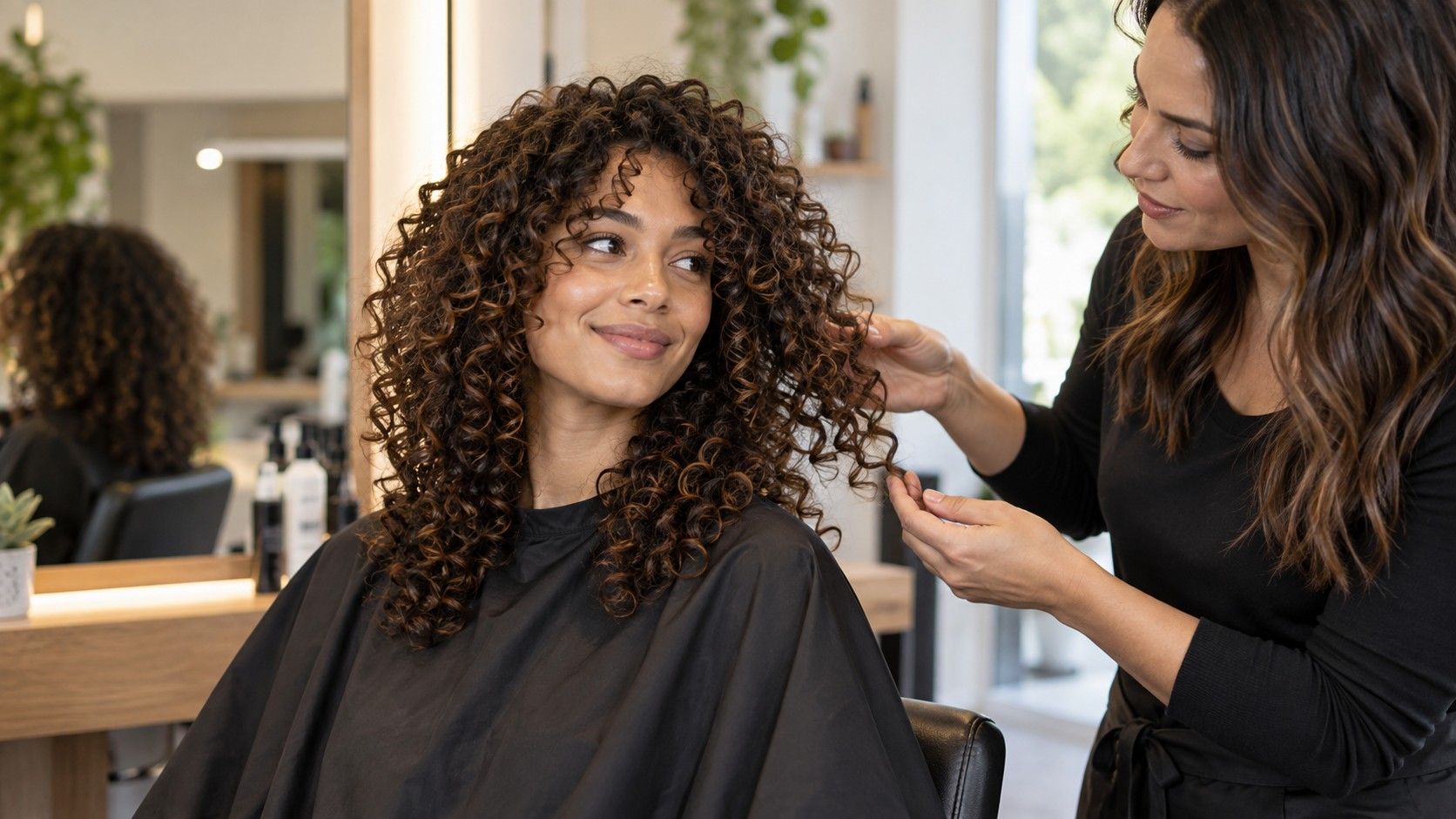
Shrinkage is the difference between a curl stretched straight and the same curl at rest. Loose waves may pull up only a little; tight coils can appear dramatically shorter. There is no reliable universal percentage because porosity, humidity, product hold, and even the width of an individual curl change the spring factor. The goal is not to calculate an exact formula. It is to prevent a request for collarbone length from becoming a chin-level shape once it dries.
Take a few photos from the front, side, and back with your usual part. In a consultation, point to your cheekbone, chin, shoulder, or collarbone rather than saying only “two inches off.” Curls do not distribute length evenly, and a curl at the nape often springs differently from one around the face. A stylist can work with landmarks; vague inches leave too much room for a painful interpretation.
Choose the short, medium, or long result you want to live in
Short curly hair makes the curl pattern prominent and can feel wonderfully light, especially when the neckline is exposed. It also puts the crown, temples, and hairline under a brighter spotlight. If your density is high, a short rounded shape may need careful internal weight removal; if it is fine, too many short layers can leave gaps that only appear after the first wash.
A medium length, somewhere between the jaw and shoulder when dry, is often the most forgiving place to experiment. It gives enough length to clip back the front on a windy day and enough structure for the curls to show a shape. The tradeoff is the shoulder zone: curls can kick outward when they meet clothing, especially at the sides. A cut that is half an inch above or below that collision point can behave completely differently.
Long curly hair offers more weight and a longer visual line, but length does not automatically mean easier control. Heavy ends can pull the crown flat, while uneven old layers create a pyramid of bulk near the shoulders. If you want length, ask how the stylist will keep lift at the root without turning the lower half into a thin curtain. The answer should mention your density and curl pattern, not a generic promise of “lots of layers.”
| Dry visual length | What it can make easier | What to check first |
|---|---|---|
| Above the jaw | Defined curl pattern and a lighter neckline | Nape cowlicks, crown density, and the amount of daily reshaping |
| Jaw to shoulder | Versatile styling and room to clip back sections | Whether the ends will hit shoulders and widen outward |
| Below the shoulder | More weight, ponytail options, and a longer silhouette | Root lift, tangling at the nape, and thin-looking ends |
Use this as a decision aid rather than a rulebook. The same visible length looks compact on a person with dense S-waves and much rounder on someone with springy ringlets. A useful mirror test is to pin your hair roughly to the proposed line, then step back several feet. You are judging the outline, not whether every curl fits the temporary pinning.
Layers decide the silhouette more than most people expect
On curly hair, layers are architecture. They can release a heavy triangle, bring curl activity upward, and stop the bottom from dragging the whole shape down. They can also create a halo of short pieces if they begin too high for your density. The right question is not “Do I need layers?” but “Where will the shortest layer sit when it is dry?”
For a rounded, bouncy shape, shorter internal layers around the crown can help, provided the top is dense enough to cover them. For an elongated silhouette, longer layers leave more weight through the sides and keep the face framing from climbing too high. A layer that looks modest while wet may bounce to eyebrow level after drying, so make the dry result part of the conversation.
Watch out for a stylist treating every curl like a straight strand. Uniform layers may make sense on smooth hair, but curly clumps form at different rates and need visual balancing. Many curl specialists assess the head section by section, then refine after the hair is dry. That is slower than a fast all-wet haircut, yet it can prevent the familiar problem of one side sitting wide while the other side drops flat.
Have a clear wet-cut versus dry-cut conversation
A dry cut is not automatically superior, and a wet cut is not automatically reckless. Some stylists use a dry curl-by-curl approach to see the final spring and silhouette in real time. Others establish a wet foundation, then dry and refine the ends. What matters is whether the process accounts for your natural shrinkage before the final length is declared finished.
Ask what state your hair should be in when you arrive. If the appointment is designed for dry cutting, arriving with stretched hair, a heavy braid-out, or product buildup hides the pattern the stylist needs to see. If it begins wet, ask whether there will be a dry check before you leave. That one question makes it harder for an ambitious trim to pass without anyone looking at the true result.
Bring the honest version of your routine into the room. Mention if you diffuse, air-dry, use gel, brush only in the shower, or refresh with water on later days. A cut assessed only after a high-shine salon finish can look different when you use a diffuser at home. The purpose is not to impress the stylist with perfect curls; it is to make the haircut work under your actual conditions.
Test a major change before making it permanent
If you are moving from long hair to a chin-length curly shape, do a rehearsal before the appointment. On dry hair, loosely coil or pin sections up to the intended line and take photos in daylight. The result will not mimic a professional cut, but it reveals what happens to your neck, glasses, parting, and overall proportions when the hair no longer covers the same areas.
Consider a staged cut when you are uncertain. Removing a moderate amount first lets you learn how much your curls rebound and whether the new shape fits your routine. A second appointment can take it shorter with better evidence. This is especially sensible after heat damage or a long period of wearing hair stretched, when you may not know the current spring factor of the healthier curl underneath.
There are practical questions too. Can you still make the bun you use for exercise? Will the front reach behind your ear? Do you mind a wash day that requires more shaping? Write down the answers before scrolling through photos. The best hair length for curly hair is the one whose maintenance you accept, not simply the one that looks most dramatic in a single image.
Protect the shape through the first few weeks at home
Fresh curls often settle after a couple of washes. Resist trimming an apparently uneven piece yourself on day two; curl clumps can rearrange as the cut relaxes and as you learn where to place product. Instead, wash and style it in your ordinary sequence, then assess the outline on two or three separate days. Take a quick back photo if you can, because the mirror is generous about areas you cannot easily see.
For definition, distribute product on very wet hair and avoid disturbing the clumps once they begin to set. For more volume, diffuse at the roots first and move the dryer rather than repeatedly raking through the ends. Neither technique is compulsory. They are useful levers when a new haircut seems too wide or too flat, and they help you tell whether the issue is styling, the length, or the structure of the cut.
Finally, book a shape check before the haircut has grown into a different category. Curly ends can hide unevenness for a while, but the outline eventually tells the truth. A small refinement can preserve the line without sacrificing months of growth. That is a calmer way to manage curly hair length than waiting until frustration makes a drastic cut feel like the only option.