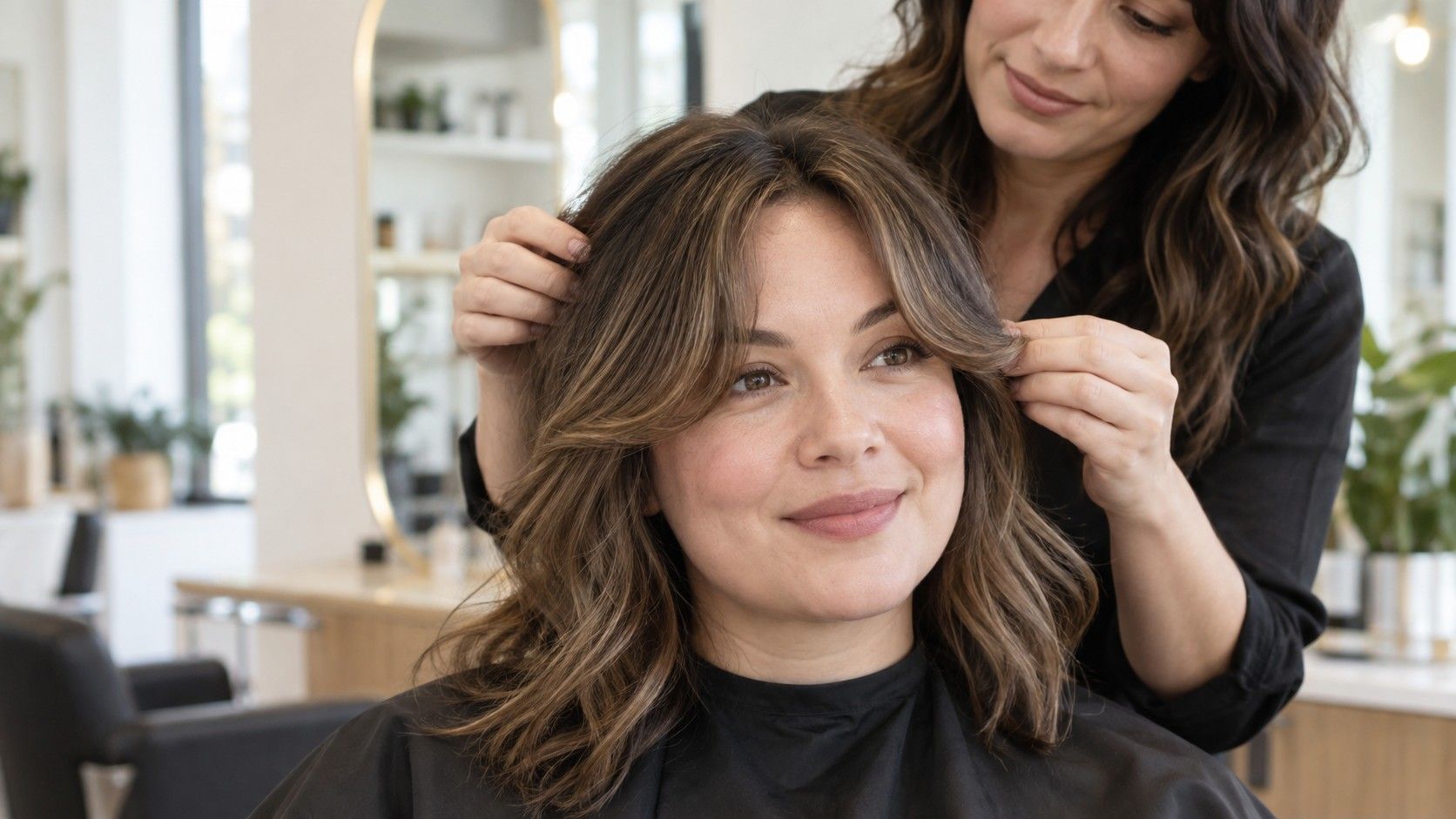
Curtain bangs look simple in a photo: a centre part, two soft pieces, and a little lift at the roots. In real life, their success comes down to a few millimetres. The right curtain bang length makes the parting look deliberate and lets the fringe move with the haircut; the wrong one sits in the eyes, springs apart over a cowlick, or stops at the widest point of the face. Before choosing a reference picture, decide which landmark you want the shortest piece to reach and how much daily styling you can honestly tolerate.
Use your own facial landmarks instead of a ruler
When a stylist says a fringe should hit the cheekbone, that is not one universal number of centimetres. Sit upright, make the part you normally wear, and find three landmarks: the brow, the high point of the cheekbone, and the corner of the jaw. A curtain fringe has a shorter inner edge and lengthens as it travels outward. That diagonal opens the face. Two equal blunt strips tend to read as an overgrown full fringe instead.
For a first appointment, it is safer for the inner point to land just below the brows when dry than to chase an ultra-short gap. Hair shrinks as it dries, especially with a wave, and a fringe that looked safely near the lashes in the cape can hover above the brow at home. Check it dry with your usual centre part. That small pause prevents the familiar surprise of pinning the front back for three weeks.
The outer edge matters too. Ending it around the cheekbone gives the most recognisable curtain effect; reaching the jaw creates a softer, longer face frame. Neither choice is automatically more flattering. Decide whether you want the fringe to draw attention upward to the eyes or blend almost invisibly into layers.
Pick short, medium, or long for an ordinary morning
Short curtain bangs begin around the brow or upper eye area and sweep toward the top of the cheekbones. They make the eyes prominent and can look sharp with a bob or compact shoulder-length cut. They also need cooperation: a damp reset, directional drying, and a willingness to notice the fringe before leaving. On fine hair, a short section can separate into strings if it is too sparse.
Medium curtain bang lengths usually start around the bridge of the nose or upper cheek and finish near the cheekbone. This is the forgiving middle. There is enough length to tuck a side away on a windy day, yet enough shape to make a plain ponytail look finished. It suits someone who can use a round brush for two minutes but does not want to rebuild the fringe after every shower.
Long curtain bangs run from cheekbone to jaw length and behave more like face-framing layers. They make sense after growing out a full fringe, when you wear hair up often, or when the hair has a strong wave. The trade-off is subtlety: on very long hair, they disappear unless there is contrast in surrounding layers. A long fringe should still have a shorter internal point, otherwise it is just a front layer with a fashionable name.
| Starting length | Outer edge | Best for | Watch out for |
|---|---|---|---|
| Brow to eye | Upper cheekbone | Defined eyes and regular styling | Dry shrinkage and hair in the eyes |
| Eye to upper cheek | Cheekbone | Most first-time curtain fringes | A heavy centre closing off the face |
| Cheekbone | Jaw or below | Growing out bangs and low-maintenance layers | Too little contrast with long front layers |
Let a cowlick set the safe starting point
A cowlick at the front is not a reason to avoid curtain bangs, but it is a reason to be cautious with the shortest point. Find it before the hair is drenched: look for the small area that pushes left, right, or straight up. If the natural growth pattern splits near the centre, a centre part can work beautifully because the fringe already wants to open. If it thrusts one section forward, a very short inner edge may keep popping out of the curve.
Dry the fringe in both directions, then settle it into the intended part. A stylist can overdirect a section with a round brush, but the real question is what happens after a walk, a hat, or a humid commute. In a difficult growth pattern, leaving the centre a touch longer and taking less density from the hairline is often wiser than cutting more layers. You can remove length at a trim; you cannot add it back before the next event.
Do not confuse a cowlick with flatness. Flat roots need lift and a short cool-down after drying. A cowlick needs the hair to be persuaded while damp, often in the opposite direction first. Those are different jobs, and a fringe that looks tame under salon lights can reveal the difference by lunchtime.
Connect the fringe to the haircut
Curtain bangs need a destination. On a blunt bob, the outer pieces often need to stay visibly separate so the cut does not become helmet-shaped. On a shag or layered cut, they can melt into the first face-framing layer. Bring hair forward and ask where that first layer begins. If the fringe ends several inches above it with no gradual bridge, it can create a shelf at the cheeks.
Texture changes the plan. Straight, dense hair shows every cutting line, so soft internal graduation and dry checking matter. Wavy hair makes the line softer, but it shortens unpredictably; cut conservatively and check the natural wave without pulling it straight. Curly hair can wear a curtain-like opening, though the result is better treated as a shaped face frame than identical smooth wings. A pin-straight reference photo should not turn good texture into a problem.
Layers affect an updo as well. A cheekbone-length curtain bang can be left out of a low bun without looking accidental. A very long one may need a pin or tuck behind the ear. If you wear a helmet, glasses, or headphones at work, mention it: pressure at the temples can split a fringe that otherwise holds its curve.
At a trim, adjust one variable at a time
The first trim is where curtain bangs become personal. Go back when the shortest pieces interrupt your sightline or when the centre part no longer sits cleanly; for many people that is four to six weeks. Arrive with hair dry and styled in its normal part, not freshly pressed flat. The stylist needs the real bend, not a temporary version created for the appointment.
Give a narrow request: shorter through the middle, softer at the cheekbones, less density, or more connection to layers. Asking for “more curtain bangs” is vague enough to invite an unnecessary redesign. If the fringe has become triangular and heavy, removing a little interior weight may help more than shortening it. If it is breaking into two limp pieces, the issue may be too little density, not too much length.
At home, wet only the fringe rather than washing the whole head. Blow it forward to erase the sleep crease, then direct each side away from the face with a small round brush or fingers. Finish with a cool shot and avoid oil on the ends; soft bangs need movement, and heavy product turns a fresh cut into separated strands. The best length is the one that makes sense on an unglamorous Tuesday morning, not only under salon lighting.